The Perennial Vote: Why Queensland Councils Cannot Stop Debating a Question That Science Has Already Answered
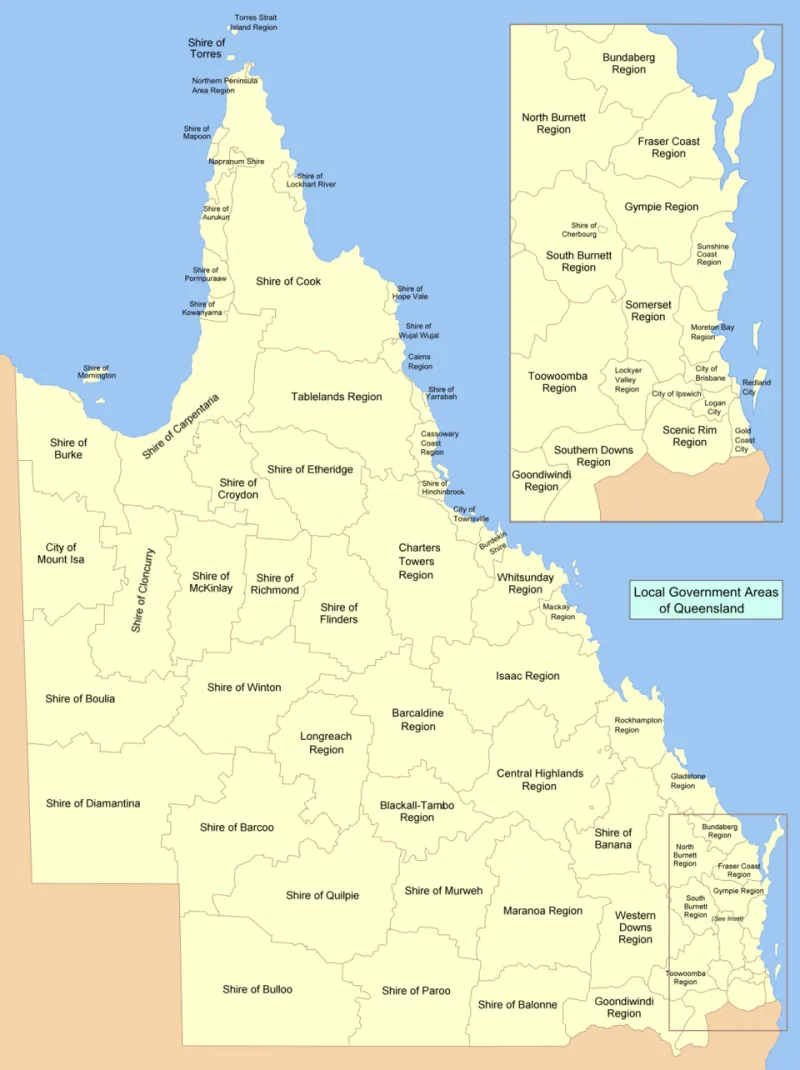
Photo: No machine-readable author provided. Roke~commonswiki assumed (based on copyright claims)., CC BY-SA 3.0, via Wikimedia Commons
There is a peculiar rhythm to local government politics in Queensland. Budgets are set, development applications are assessed, infrastructure is planned and occasionally built. Most policy decisions, once made, stay made — adjusted at the margins perhaps, but not fundamentally relitigated with each change of council composition.
And then there is fluoridation.
With a regularity that would be almost comic if the public health stakes were not genuine, water fluoridation returns to Queensland council agendas. Petitions are tabled. Deputations are heard. Councillors who were not present for the last debate rehearse arguments that were made — and answered — years or decades earlier. The community divides along familiar lines. A vote is eventually taken. And the cycle resets.
Understanding why this happens — and what it costs — requires looking beyond the scientific evidence, which has been stable for generations, and into the political psychology that keeps a settled question perpetually unsettled.
A Policy That Was Never Fully Owned
Fluoridation in Queensland has an unusual legislative history that partly explains its political vulnerability. For much of the late twentieth century, fluoridation decisions were left to local councils — a decentralised arrangement that produced a patchwork of fluoridated and non-fluoridated communities across the state. The Bligh Government's 2008 decision to mandate fluoridation statewide through the Water Fluoridation Act removed that local discretion, bringing Queensland into line with most other Australian states.
That legislative shift resolved the practical question of who decides — the state government — but it did not resolve the political question of whether local communities feel that the decision belongs to them. For councils and community groups that opposed the mandate, the 2008 legislation represented an imposition rather than a resolution. The political energy that was suppressed by state-level mandate did not dissipate; it simply waited for the next election cycle to find an outlet.
When councils do not have the legal authority to reverse fluoridation, the debate becomes performative — a public expression of grievance rather than a genuine policy process. This performative quality does not make the debates less disruptive. It makes them more so, because they consume political capital and public attention without any realistic prospect of changing the underlying policy.
The Anatomy of a Recurring Campaign
The fluoridation debate, as it tends to appear in Queensland local government, follows a recognisable structure. A candidate or a small group of existing councillors raises the issue, typically framed around community consent, bodily autonomy, or unspecified health concerns. A petition circulates. Community meetings are held, often dominated by a vocal minority whose passion for the issue outweighs their representativeness.
Experts are sometimes invited to present — health officers, dental professionals, or representatives of Queensland Health. Their evidence is received, noted, and frequently set aside in favour of testimony from community members who report personal adverse experiences or cite sources that do not meet the standards of peer-reviewed scientific literature.
A vote is taken. In most cases, particularly at the state level, the outcome affirms existing policy. In some historical cases at the local level, particularly before 2008, the outcome has gone the other way — producing communities that removed fluoride from their water supply and, in documented cases, subsequently experienced measurable increases in childhood dental decay rates.
The process is then repeated, in some form, at the next election. New councillors arrive with the same mandate from the same vocal constituency. The cycle begins again.
The Cost That Nobody Calculates
Every iteration of this cycle carries costs that are rarely tallied. Staff time within council administrations, health departments, and water utilities is consumed responding to consultation processes, preparing briefing materials, and attending public meetings. Legal advice may be sought regarding the council's powers under the Water Fluoridation Act. Community health organisations divert advocacy resources toward a debate that should not need to be had.
For Queensland Health and the state government, each local fluoridation campaign requires a response — correcting misinformation in the public domain, supporting local health officers, and occasionally intervening when council discussions approach the boundary of what the legislation permits.
None of this expenditure is formally attributed to the fluoridation debate in any public accounting. It is absorbed into general administrative costs and rendered invisible. If it were made visible — if a council were required to publish the full cost of conducting a fluoridation review, including staff time, expert fees, and community engagement expenses — the figure would likely surprise residents who might reasonably ask whether those resources could be better directed.
Why This Issue and Not Others
Many public health interventions are mandated without generating perpetual community revolt. Chlorination of water supplies, pasteurisation of milk, mandatory seatbelt legislation, and childhood immunisation schedules have all faced opposition at various points in Australian history. Most of that opposition has subsided, or at least ceased to produce recurring council debates.
Fluoridation is different, and the reasons are worth examining honestly.
Part of the explanation lies in the invisibility of the intervention. Unlike a vaccine, which is administered at a specific time and place, or a seatbelt, which requires a conscious act, fluoridated water is simply present in the tap. It cannot be seen, tasted, or smelled. For individuals who are already inclined toward suspicion of government action, an invisible additive in the public water supply is a uniquely potent symbol.
Part of the explanation also lies in the nature of the benefit. Fluoridation prevents dental decay at the population level — a statistical outcome spread across thousands of people over years. It does not produce a visible, attributable benefit to any individual on any given day. Harms, even when they are not causally linked to fluoridation, are far more emotionally salient than diffuse preventive benefits. The person who develops a health problem and attributes it to fluoride is a compelling presence at a council meeting. The child who did not develop dental decay because of fluoridated water is an invisible statistic.
Finally, fluoridation intersects with deeply held values around bodily autonomy and consent. The argument that individuals should have the right to choose what enters their bodies is not irrational — it is a legitimate ethical principle. The response that population-level public health interventions necessarily operate at the collective rather than individual level is also legitimate, but it requires a more complex chain of reasoning that is harder to communicate in a council chamber.
What Settled Science Looks Like in Practice
The scientific consensus on community water fluoridation is not genuinely contested within the relevant research communities. Major Australian and international health authorities — including the National Health and Medical Research Council, the World Health Organisation, and the Australian Dental Association — maintain consistent positions supporting fluoridation as safe and effective at recommended concentrations.
This does not mean the science is beyond scrutiny. Legitimate research continues, and specific questions — about optimal concentration levels, about particular subpopulations, about the relative contribution of fluoridation compared to other preventive interventions — remain areas of active inquiry. Science is not static.
What is not a live scientific question is whether community water fluoridation at Queensland's current concentrations causes the harms that are typically alleged in council debates. That question has been examined extensively and the evidence does not support the allegations. Repeating the debate in a council chamber does not reopen the science; it simply provides a platform for claims that the science has not validated.
The Democratic Tension Without a Clean Resolution
None of this analysis resolves the genuine democratic tension at the heart of the fluoridation debate. Communities do have legitimate interests in how their water is treated. Public trust in health institutions is not automatic and must be earned and maintained. The experience of being told that a decision has been made and will not be revisited is, for some residents, alienating rather than reassuring.
What Queensland's recurring fluoridation debates suggest is that the public health system has not yet found a way to honour those democratic instincts while also maintaining the integrity of evidence-based policy. Information campaigns, community engagement, and transparent communication about the evidence base are tools that have been deployed with varying degrees of consistency and success.
Until the communication gap is closed — until communities feel genuinely informed rather than simply overruled — the fluoridation debate will return. Not because the science is uncertain, but because the politics never fully resolved in the first place.